Healthcare
Key driver: Process
Advanced Surgical Pavilion
Northwell was planning a new surgical pavilion at North Shore University Hospital. Before it opened, we studied today's elective surgery experience, from booking to discharge, so the new building wouldn't repeat its problems.
My role
UX Research & Service Design
Organisation
Northwell Health, New York
When
Nov 2021 – May 2022
Research
On-site visits, interviews, thousands of survey responses
3
layers in one journey map: patient, caregiver and staff
8
deep dives into pain points, from belongings to discharge
4
solution areas, each owned by a hospital council
My role
Collaborating with Northwell's Digital Patient Experience team, I worked on the research (including some of the interviews), the workshops, the synthesis and the journey map.
01 · The brief
Design the experience before the building is finished.
Understand today's elective surgery experience at North Shore University Hospital from three points of view, patients, caregivers and staff, and use it to shape the new pavilion.
Research
Three on-site visits in December 2021, about three weeks of phone interviews with patients and staff, and thousands of patient survey responses coded and sorted.
What we saw
Check-in
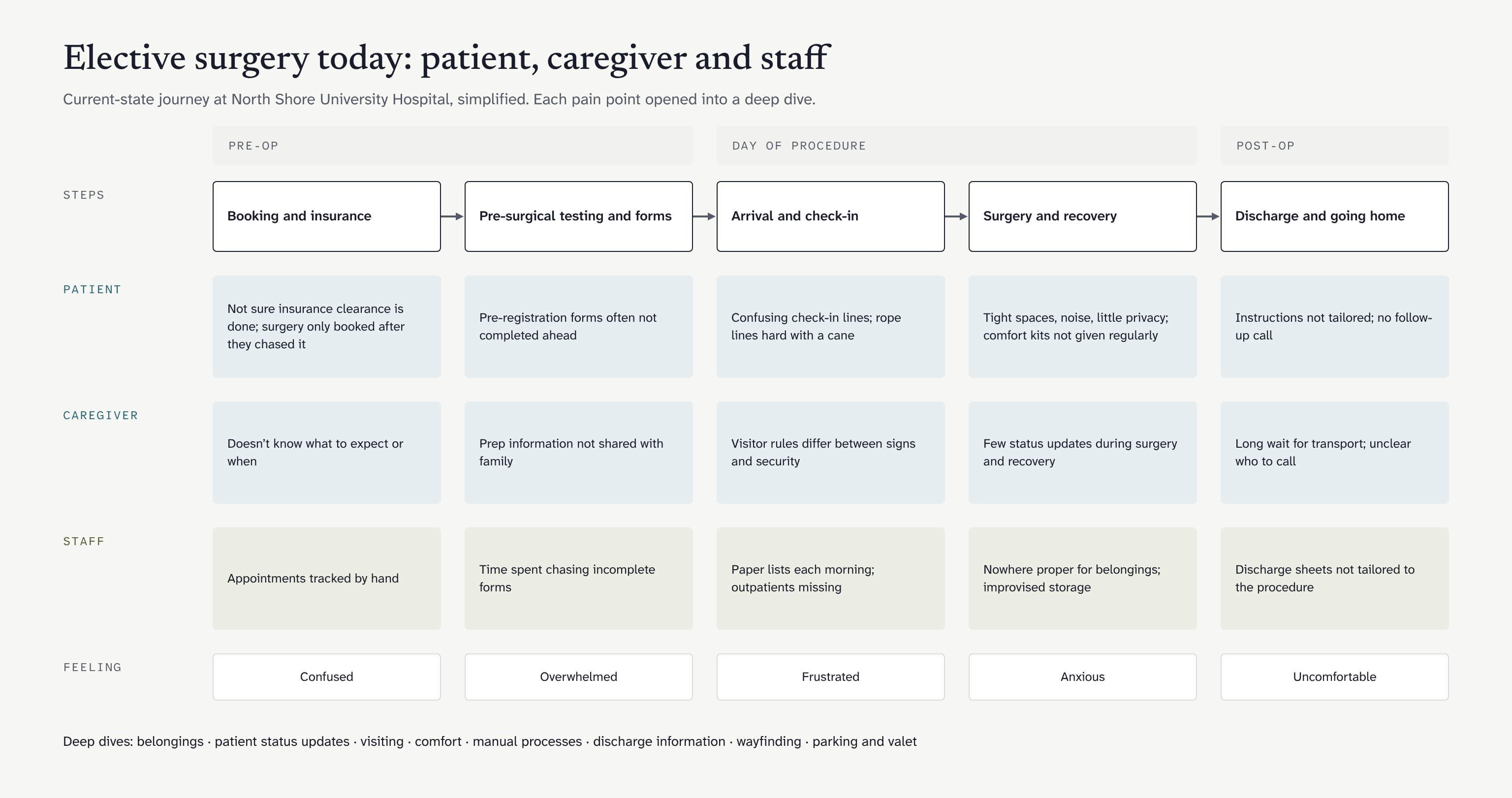
People queued in the wrong line and had to start again. An older woman with a cane took about a minute to get through the rope lines.
Belongings
With nowhere proper to keep belongings, staff improvised their own ways to keep valuables safe.
Finding the way
Outpatient lists arrived each morning on paper, so guest services often didn't know where someone was heading.
Going home
Discharge instructions weren't always tailored to the procedure the patient had just had.

02 · The journey map
One map, three people.
We built one journey map with three layers, patient, caregiver and staff, across pre-op, the day of surgery and post-op. Pain points open into eight deep dives: belongings, patient status updates, visiting, comfort, manual processes, discharge information, wayfinding, and parking.
Giving it owners
We worked with the hospital to hand each part of the journey to an existing Patient Experience Council, for the operating rooms, surgery and guest services, and ran workshops with each to agree the problems and ideas.
03 · Four solution areas
One hub for surgery prep
The same information for patients and staff, shareable with family.
Automated booking
With room for staff to step in when plans change.
An experience navigator
A person or a digital guide patients can ask anything.
A proper system for belongings
So nothing depends on improvisation.
The storyboard
Pat, in her mid-50s, needs knee surgery. The app books her tests, reminds her what to bring and when to stop eating, answers her question about vitamins through a navigator, and shares her discharge instructions with her family.

What happened
The steering committee used the storyboard to agree on the approach for the pavilion.
What I'd take forward
The map only worked because every part of the journey had an owner. Handing pain points to councils that would still be there next year, not to a project team about to leave, is how the work kept going.
More projects
2021
Caring for Caregivers
Northwell DPX · Healthcare · People
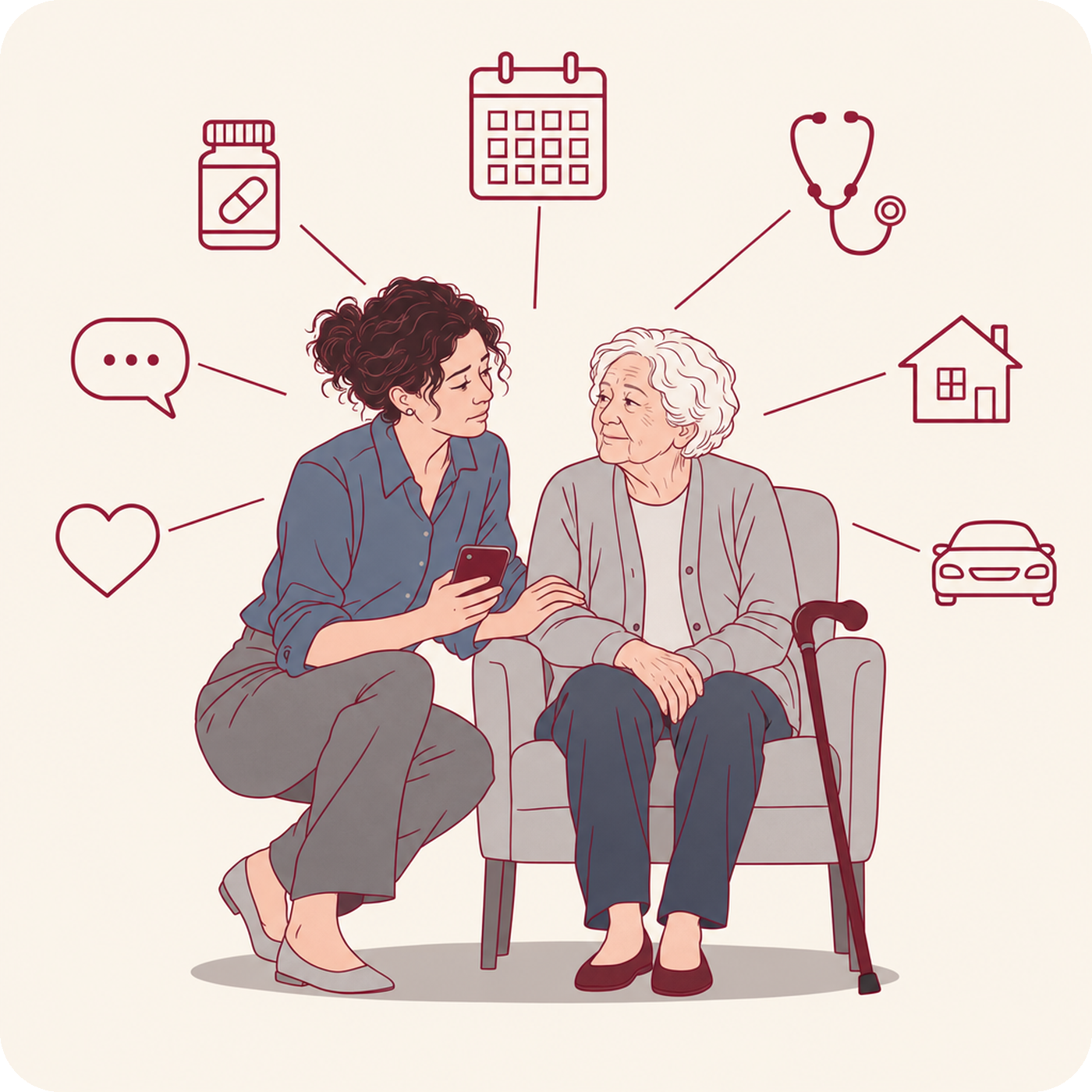
Family caregivers carry more than anyone in the health system, with the least support. We designed an ecosystem around them.
2021
Household Health Hub
Northwell DPX · Healthcare · Platform
In most families one person tracks everyone's appointments and prescriptions. We designed and tested an app for that person.

Working on a regulated service?
I’m always glad to compare notes with people in finance, healthcare or the public sector, especially if you’re working out where AI belongs.